Downtown Medford
Medford was established in 1883 when the Oregon & California Railroad, a forerunner of the Southern Pacific, decided laying track to Jacksonville's mountainous corner of the Rogue Valley wasn't practical. Perhaps that decision was inspired by the landowners who offered to give the O & C huge tracts of land if they'd build their depot at a "new town on the valley floor." The town was named Medford by David Loring, the railroad's engineer, after his hometown in Massachusetts. When the first train pulled into the depot in Spring 1884 crude wooden stores and taverns lined "Front Street," facing the tracks. Further east, near Bear Creek, the "County Road" connected Medford to the surrounding towns.
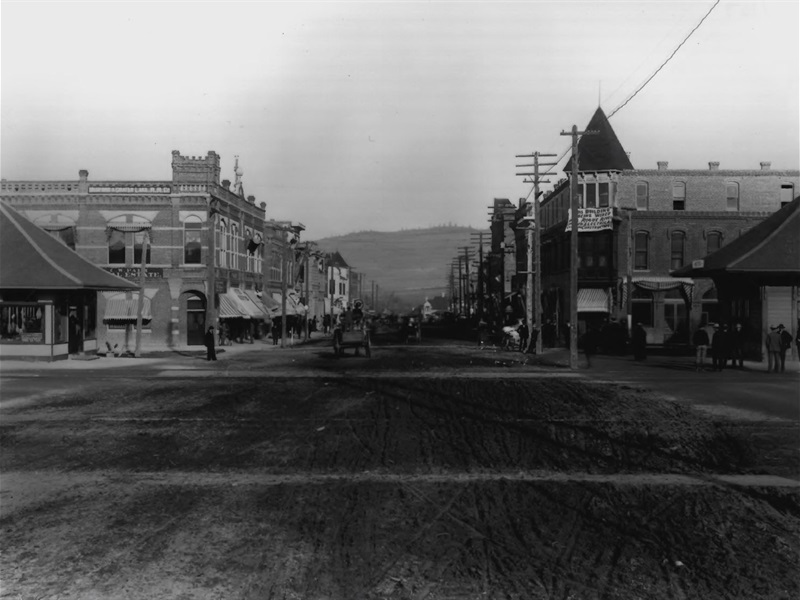
Incorporated in 1885, Medford prospered and its population grew, surpassing Jacksonville by 1900. Merchants replaced their wooden buildings with fine brick ones and fancy homes were built near the commercial district by leading citizens. In 1902 the first brick building on the other side of the tracks was completed and downtown expanded westward. Professional architects first arrived in the late 1890s and by 1910 Frank Chamberlain Clark moved to Medford, where he designed and remodeled many of the city's most important structures over the next 50 years.

While its earliest residents had planted crops and the depot provided shipping for the surrounding farms, a new influx of investors, many from Chicago, Illinois, dramatically increased the valley's orchard production during the early 20th century. Acre after acre was planted and "Orchard Tracts" were sold at astronomical prices to these wealth "colonists." Newcomers swelled Medford's population by almost 400% between 1900 and 1910, making it the third fastest growing city in the United States. The "Orchard Boom" brought new building and remodeling as Medford's prospering downtown modernized. Phones and electric lines appeared and Medford built its first publicly-owned City Hall in 1908. The "University Club," a social gathering spot for well-educated colonists, was begun by early orchardists. By 1910 Medford's population was 8,800, surpassing Ashland, and making it the largest city in Southern Oregon.

Medford quickly adopted the automobile and boasted more that 18 miles of improved road by 1912. Jackson County was the first county in Oregon to offer a paved route from end-to-end, while Oregon was the first state west of the Mississippi able to make such a claim. That route, the Pacific Highway, followed the old "County Road" along Riverside Avenue through downtown, and ultimately connected British Columbia to Mexico. With over 2,000 miles this "Road of Three Nations" was the longest paved road in the world by 1926.

The Orchard Boom had ended by 1915, when over-planting and drought killed off many of the trees and Medford's population plummeted by almost 35%. After WWI the city enjoyed renewed growth during the "Roaring" 1920s. The decade brought movie theaters, restaurants, new car dealers, gas stations and repair shops to downtown. Architects turned to new styles, mostly a simple version of Art Deco, and many early brick buildings were "modernized" beneath stucco coverings. Gaining status as the Jackson County seat in 1926, Medford was booming when the stock market crash of 1929 virtually halted development. The frustration of those hard times led in part to the ill-fated "Jackson County Rebellion" that dominated local politics during the early 1930s.
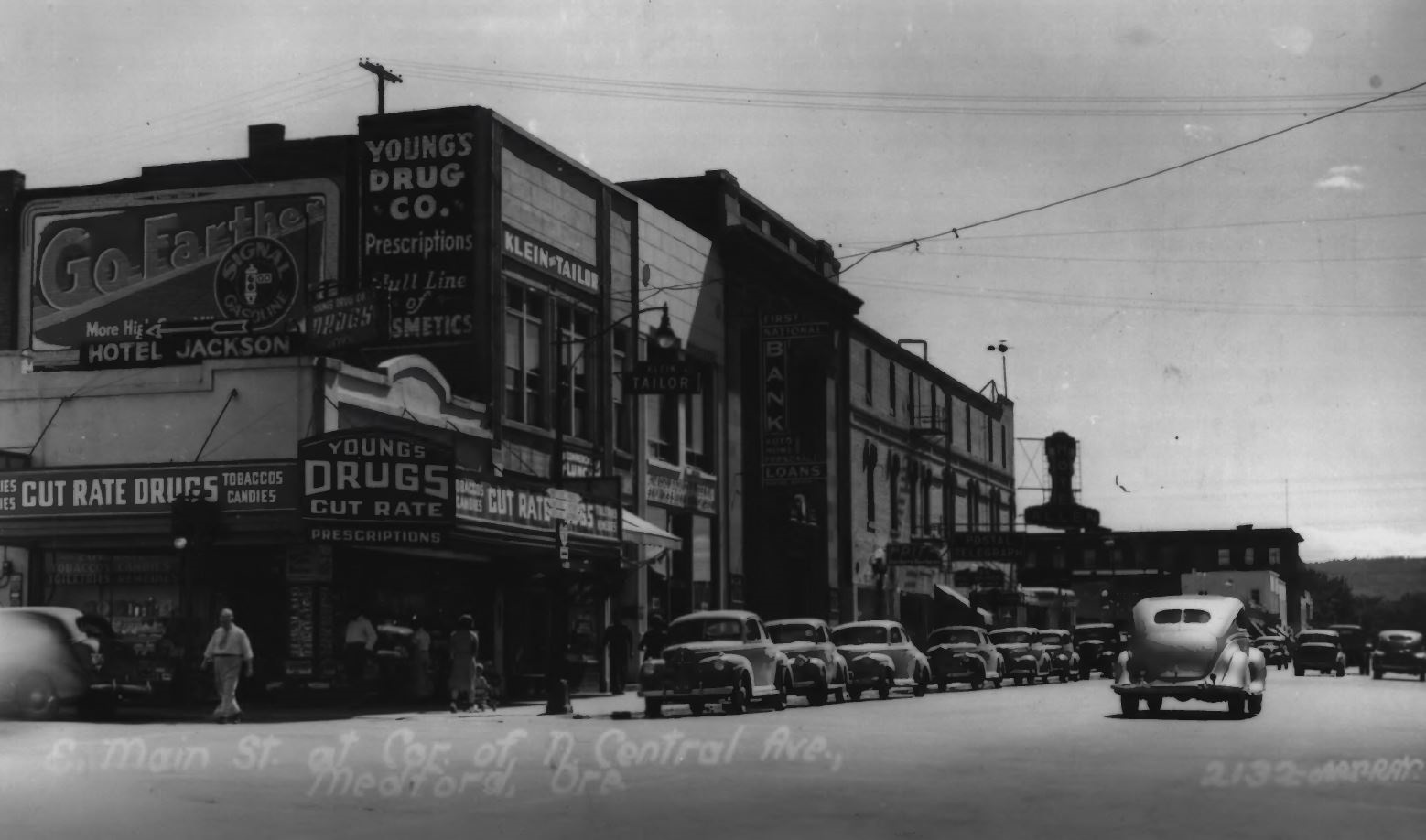
Like much of the nation, Medford was slowly inching its way out of the Depression when huge government investments during WWII brought prosperity back with a vengeance. Camp White, a U.S. Army training facility built on more than 40,000 acres of land north of the city, brought 10,000 construction workers followed by more than 40,000 military personnel to a city whose population in 1940 was just 11,000. After WWII, Camp White was closed and portions of its facilities were taken over the southern Oregon's growing lumber industry. With the postwar housing boom creating a huge demand, timber overtook agriculture as the area's most influential industry. With a growing population, Medford became the primary financial, medical and professional service center for all of southern Oregon. Merchants again invested in downtown property, removed "outdated" features, and buildings were remodeled in the newest "International" style. Some, like the J.C. Penney store are classic examples of the era. Much of the development, however, was under taken with little respect for downtown's history and many wonderful buildings from Medford's early years were stripped of their detail or torn down. Those transitions, all reflections of the area's economic success, still characterize many of downtown's buildings, where even today over 150 structures pre-date 1941.

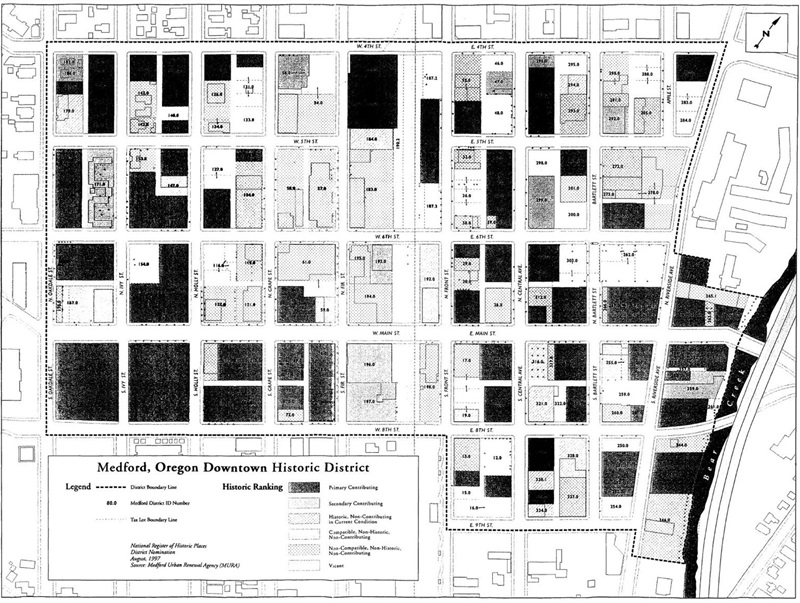
By the early 1960s, downtown Medford, no longer focused on the railroad and bypassed by the opening of Interstate 5, faced increased competition from the Medford Shopping Center and then, in the late 1980s, from the Rogue Valley Mall. Vacant buildings and declining rents followed the relocation of national companies such as J.C. Penney and Woolwoorth's. But today downtown Medford remains a hub of specialty retailers that emphasize personal service and quality products, fine restaurants, and a performing arts center. Recognition of downtown's significant role in Medford's history led to a district nomination to the National Register of Historic Places (NRHP) in 1997.
NRHP Downtown Nomination Form