Council Discusses Next Steps for Proposed Creekside Quarter Concept
Published on February 27, 2026
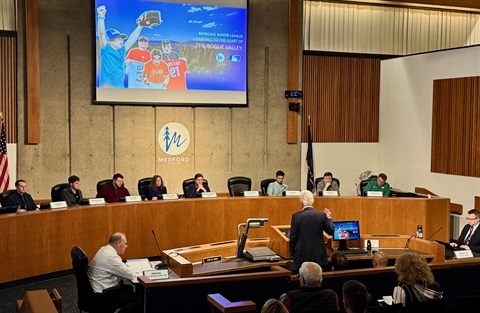
At its Feb. 25 study session, the Medford City Council discussed the next steps for the proposed Creekside Quarter concept in downtown Medford. The west side of the site would feature a hotel, a conference and event center, and commercial spaces, while a professional baseball stadium would be located on the east side of Bear Creek.
West Side Component
The west side component would be privately developed, with negotiations between the City and the developer still ongoing. The developer has not yet secured the property, and the timeline for obtaining control is uncertain.
Conference Center Next Steps
A regional conference center, initially proposed as a privately funded project, has been discussed for several years. A City-funded feasibility study published in fall 2024 concluded the project would be viable if partially supported by public funding, such as the transient lodging tax (TLT).
On Wednesday, Council asked City staff to prepare a broad proposal for a conference center and hotel for potential developers. In the Nov. 4, 2025, Special Election, voters approved increasing the TLT from 11% to 13% to help fund the center.
Stadium Component
In 2024, the Eugene Emeralds Minor League Baseball Team approached the City and pitched the idea of moving south. In 2025, the City contracted an architectural design consulting firm specializing in sports venues to prepare conceptual drawings for a stadium located in Hawthorne Park.
The design includes a seating capacity of 3,992, with 2,392 fixed seats, and the field and facilities would meet all minimum Minor League Baseball stadium standards. The facility would not provide on-site parking for fans.
Based on these preliminary plans, two local contractors provided potential cost estimates averaging $86 million. Councilors also reviewed a case study of a similar-sized stadium in Everett, Washington, where an originally approved $82 million project—now 60 percent complete—is estimated at $102 million. Additionally, a global construction company estimated the stadium at $115 million.
These preliminary estimates are based solely on early-stage designs and carry an accuracy range of approximately ±30 percent. Determining a more precise stadium cost will require further preliminary engineering, environmental and geotechnical investigations, and detailed design work.
Proposed Stadium Costs and Funding Sources
Under the $86 million scenario, the City would need to issue $60 million in bonds, which would accrue approximately $57.1 million in interest. Total debt repayment would be $117.1 million, and the overall project cost would reach roughly $143.1 million.
Over 30 years, potential sources to repay the bonds could include a Medford Urban Renewal Agency (MURA) 2.0 tax increment, a 2% increase in the car rental tax, a $1 increase in the Park Utility Fee for 15 years, lease payments from the team, naming rights revenue, Parks System Development Charges, and other unspecified sources. A one-time capital contribution from the team, the state, or other partners would also be required.
The percentage contribution from each source would depend on the final bond amount, which is contingent on the ultimate stadium cost.
Stadium Discussion and Next Steps
DG Elmore, owner of the Eugene Emeralds, and Major League Baseball officials, including Peter Woodfork, Casey Brett, and Randy Winn, addressed the Council. They highlighted the stadium’s potential as a community asset to generate economic activity, provide affordable family entertainment, and support player development.
Council members discussed the opportunities and risks and emphasized the need for a more precise stadium cost estimate. They directed City staff to prepare a request for proposals for additional preliminary engineering for a stadium, with the total estimated cost of $500,000–$1 million to be covered by MURA 1.0 funds and a contribution from the Emeralds (the specifics of which will be negotiated by staff). Some Councilors emphasized a need for significant financial participation from the team.
To watch the study session, click here.