E-Bike Safety: Know the Rules Before You Ride
Published on September 15, 2026
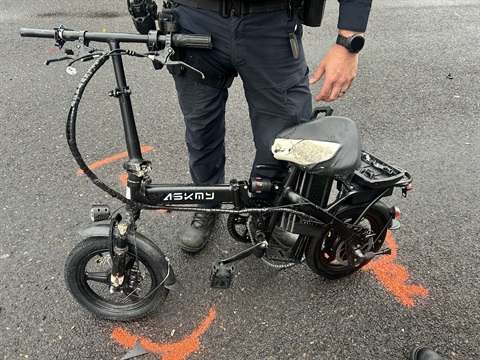
As e-bikes are becoming increasingly popular, do you know the rules that apply to them?
Oregon has specific requirements depending on the type of vehicle and its capabilities, including age limits, helmet and licensing requirements, speed restrictions, and where you can ride.
E-Bike Basics
Here are some important rules to know before you ride
- You must be at least 16 years old to operate an e-bike on any public road or path in Oregon.
- E-bikes cannot be ridden on sidewalks statewide under ORS 814.410.
- Keep e-bikes on roads and bike lanes.
- E-bikes must follow standard traffic laws, and citations can be issued to the juvenile and parent or guardian, in addition to impound fees.
What About Helmets?
In Oregon, helmets are required for riders under the age of 16. Because riders must be at least 16 to legally operate an e-bike on a public road or path, the helmet requirement does not apply to lawful e-bike operators.
That doesn't mean you should skip the helmet. A crash at 20 or 28 mph can result in devastating head injuries, so wear your helmet every time you ride.
Know Your E-Bike's Class
Not all e-bikes are the same. Oregon's e-bike classifications are based on how the motor assists the rider and the speed at which that assistance stops.
- Class 1 e-bikes have a motor that provides pedal assistance and stops assisting once the bike reaches 20 mph. These models do not have a throttle.
- Class 2 e-bikes also have a maximum assisted speed of 20 mph, but they are equipped with a throttle. The throttle allows the rider to engage the motor and propel the bike without pedaling. These e-bikes cannot provide assistance beyond 20 mph.
- Class 3 e-bikes are the fastest category under this system. Like Class 1, they are pedal-assist only and do not have a throttle that can be used independently. However, the motor provides assistance until the bike reaches 28 mph. Because of their higher speed capabilities, Class 3 e-bikes are legally required to have a speedometer. They may also face additional restrictions on shared-use paths depending on the jurisdiction.
When an E-Bike Becomes a Motor Vehicle
An electric bicycle with a motor exceeding 750 watts or capable of speeds beyond its class limit no longer qualifies as an e-bike under Oregon law.
These vehicles are treated as motor vehicles (similar to mopeds). Riders are required to have a valid driver's license and vehicle registration, and the vehicle is subject to standard driving laws.
If you have modified your e-bike's motor or speed controller, make sure it still falls within the legal thresholds. An aftermarket upgrade that pushes the motor beyond 750 watts can change the vehicle's legal status.
Gas-assisted bicycles are considered mopeds.
What About E-Scooters?
E-scooters have their own requirements.
- You must be at least 16 years old to operate an e-scooter.
- Helmets are required regardless of age under ORS 814.534. Religious exemptions apply.
- A motor must be 35 cc or less and the vehicle cannot travel faster than 15 mph.
- If the vehicle is electric, its power output cannot exceed 1,000 watts.
What About E-Motorcycles?
Some electric motorcycles, including "Sur-Ron" style motorcycles, are capable of speeds greater than 30 mph. These vehicles are considered motorcycles, not e-bikes.
They are subject to requirements for registration, insurance, and a driver's license with a motorcycle endorsement.
As a quick reference, if the vehicle has foot pegs instead of pedals and a bracket for a license plate, it most likely falls under the motorcycle category.
Before You Ride
Before heading out, make sure you know what type of vehicle you are operating and understand the rules that apply to it. Knowing the rules can help keep you safe and legal on the road.